
World Cup 2026 Betting Calculators: Odds, Goals, Scores, Groups & Bracket Tools
The 2026 World Cup is not just a bigger football tournament. It is a different betting environment: 48 teams, 12 groups, 104 matches, a Round of 32, and eight third-placed teams qualifying for the knockout stage. That format creates more scenarios, more market types, and more ways to misread betting odds.
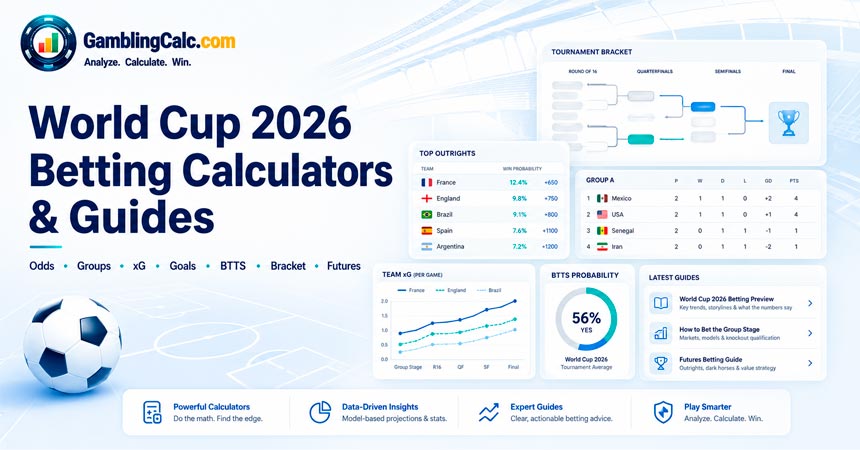
This hub brings together the main World Cup 2026 betting calculators on GamblingCalc. Use them to remove bookmaker margin, convert xG into fair odds, price correct scores, compare over/under goals, check BTTS probability, model cards and corners, calculate group scenarios, map bracket paths, evaluate futures hedges and compare cash-out offers.
Tournament format and schedule are based on FIFA’s published World Cup 2026 information: match schedule, group qualification rules, and format explainer.
Start with the market, not the team
A World Cup bet should not begin with “I like this team.” It should begin with a market question:
is the 1X2 price overround too high, does the xG model support the goal line, is the BTTS price fair,
does the handicap line match the likely goal-difference distribution, or does the knockout market settle on
90 minutes only?
These calculators are not prediction guarantees. They are baseline tools for comparing your assumptions with
the market price. Any possible edge comes from the gap between fair probability and bookmaker probability.
World Cup 2026 guides
World Cup 2026 betting guides and strategy articles
Use these World Cup 2026 betting guides with the calculators below. The articles explain tournament format,
odds types, group qualification, match markets, futures, live betting, props and bankroll decisions.
Format, groups and tournament rules
Odds, futures and bankroll basics
Match betting markets
Knockout, live betting and ticket value
World Cup 2026 tournament scenario calculators
These tools are specific to the tournament structure: 12 groups, best third-placed teams, a Round of 32 bracket,
knockout paths and qualification logic.
World Cup 2026 Group Stage Calculator
Enter match scores for one four-team group and update points, goal difference, goals scored and qualification status.
- Best for: group-table scenarios
- Outputs: standings, tiebreakers, top-two status
- Use case: “What does this team need to qualify?”
Third-Place Qualification Calculator
Compare all 12 third-placed teams and identify which eight qualify for the Round of 32.
- Best for: best-third-place scenarios
- Outputs: 12-team ranking table
- Use case: “Is four points enough to qualify?”
World Cup 2026 Bracket Calculator
Map the knockout path from the Round of 32 to the final using editable team slots and rating assumptions.
- Best for: route-to-final analysis
- Outputs: projected bracket path
- Use case: compare path difficulty for futures bets
90-Minute vs Extra Time Betting
Check how World Cup knockout markets settle: 90-minute result, extra time, penalties, to qualify or lift trophy.
- Best for: settlement-rule checks
- Outputs: win/loss/push result by market type
- Use case: avoid confusing “team to win” with “team to qualify”
World Cup 2026 odds and probability calculators
These tools convert prices or model assumptions into fair probabilities. Use them before comparing bookmaker odds
with your own view.
World Cup 2026 No-Vig Odds Calculator
Remove bookmaker margin from 1X2, group winner, to-qualify, outright and futures markets.
- Best for: fair market probability
- Outputs: no-vig probability and fair odds
- Use case: compare sportsbook prices without overround
World Cup 2026 xG to Odds Calculator
Convert projected expected goals into 1X2, over/under, BTTS and correct-score probabilities.
- Best for: model-based pricing
- Outputs: fair odds across major match markets
- Use case: compare your xG assumptions with the market
World Cup 2026 Over/Under Goals Calculator
Estimate fair odds for common goal lines such as over/under 1.5, 2.5, 3.5, 4.5 and 5.5.
- Best for: totals markets
- Outputs: over/under probabilities by line
- Use case: check whether over 2.5 or under 2.5 is mispriced
World Cup 2026 BTTS Calculator
Estimate Both Teams To Score Yes/No probability from each team’s projected xG.
- Best for: BTTS markets
- Outputs: BTTS Yes, BTTS No, clean-sheet components
- Use case: separate total-goals expectation from both-team scoring risk
World Cup 2026 Correct Score Calculator
Build a correct-score matrix from projected xG and compare exact score probabilities with bookmaker prices.
- Best for: exact-score markets
- Outputs: score matrix, top scorelines, fair odds
- Use case: check whether 1-1, 2-1 or 0-0 is realistically priced
World Cup 2026 Asian Handicap Calculator
Price Asian handicap lines from projected xG, including push, half-win and half-loss outcomes.
- Best for: handicap markets
- Outputs: fair AH odds and expected ROI
- Use case: compare favourite/underdog handicap value against 1X2
World Cup 2026 cards, corners and bet builder calculators
These markets are more sensitive to referee profile, game state, territory, pressure and correlation. Treat them
as scenario tools rather than fixed predictions.
World Cup 2026 Cards Calculator
Estimate yellow cards, booking points and over/under card-line probabilities from team, referee and pressure inputs.
- Best for: cards and booking-points markets
- Outputs: projected cards, booking points, line probabilities
- Use case: check knockout or high-pressure card scenarios
World Cup 2026 Corners Calculator
Estimate total corners, team corners and over/under corner-line probabilities from team and opponent inputs.
- Best for: corners markets
- Outputs: team corners, total corners, fair odds
- Use case: favourite vs low-block corner pressure
World Cup 2026 Bet Builder Calculator
Estimate same-game multi probability, fair odds and bookmaker edge after a correlation adjustment.
- Best for: same-game multis
- Outputs: independent probability, adjusted probability, payout
- Use case: check whether result + goals + BTTS is fairly priced
World Cup 2026 futures, cash-out and top scorer calculators
These tools are most useful before the tournament, during the group stage, and late in the knockout rounds when
futures tickets can change value quickly.
World Cup 2026 Futures Hedge Calculator
Test hedge stakes for outright, group winner, to-qualify and other futures positions.
- Best for: open futures tickets
- Outputs: hedge stake, locked profit, downside protection
- Use case: hedge a long-shot ticket before a semi-final or final
World Cup 2026 Cash-Out Calculator
Compare a sportsbook cash-out offer with the fair value of your open ticket.
- Best for: cash-out decisions
- Outputs: fair ticket value, implied probability, offer gap
- Use case: decide whether the offer is above or below your fair valuation
World Cup 2026 Golden Boot Calculator
Estimate a player’s scoring range from xG per 90, minutes, projected matches and penalty role.
- Best for: top scorer futures
- Outputs: expected goals, goal-target probabilities, fair odds
- Use case: compare Golden Boot odds with a player’s scoring profile
Which World Cup calculator should you use?
| Question | Use this calculator | Why it fits |
|---|---|---|
| What does a team need to qualify from its group? | Group Stage Calculator | It tracks points, goal difference, tiebreakers and top-two status. |
| Can a third-placed team still reach the Round of 32? | Third-Place Qualification Calculator | It compares all 12 third-placed teams and marks the top eight. |
| Are the match result odds fair? | No-Vig Odds Calculator | It removes bookmaker margin and shows fair market probabilities. |
| What should the fair odds be from projected xG? | xG to Odds Calculator | It converts expected goals into 1X2, totals, BTTS and score probabilities. |
| Is over 2.5 or under 2.5 mispriced? | Over/Under Goals Calculator | It estimates fair prices for common goal lines. |
| Will both teams score? | BTTS Calculator | It separates both-team scoring probability from total-goals expectation. |
| Is a correct-score price realistic? | Correct Score Calculator | It builds a score matrix instead of guessing one exact scoreline. |
| Is an Asian handicap line fairly priced? | Asian Handicap Calculator | It handles push, half-win and half-loss settlement from xG. |
| Does a knockout bet include extra time or penalties? | 90-Minute vs Extra Time Guide | It checks settlement basis and payout logic. |
| Is a cash-out offer fair? | Cash-Out Calculator | It compares the offer with fair ticket value. |
Example workflow for a World Cup match
-
Start with market price.
Enter 1X2, totals or futures odds into the
No-Vig Odds Calculator
to remove bookmaker margin. -
Build your own baseline.
Estimate projected xG for both teams and use the
xG to Odds Calculator. -
Check derived markets.
Use the goal, BTTS, correct score and Asian handicap calculators to see whether the same assumptions support
the side market. -
Check tournament context.
Use the group-stage, third-place and bracket calculators to understand incentives and path risk. -
Check settlement rules.
For knockout markets, confirm whether the bet settles on 90 minutes, extra time, penalties or qualification. -
Only then judge value.
A bet is not attractive because it is likely to win. It is attractive only if the available odds are higher
than your fair price.
What these calculators cannot do
No World Cup betting calculator can guarantee a profitable bet. Football models are sensitive to input quality,
especially in international tournaments where team samples are smaller, lineups change, and knockout incentives
can alter tactics.
Use these tools for probability comparison, not certainty. If your xG, card, corner, path or probability input is
wrong, the fair odds will be wrong. If team news changes, your pre-match estimate may become stale. If the bookmaker
price moves, the value calculation changes with it.
World Cup 2026 betting calculator FAQ
What is the best calculator to use before a World Cup match?
Start with the No-Vig Odds Calculator if you already have bookmaker odds. If you have projected xG for both teams,
use the xG to Odds Calculator because it can produce 1X2, over/under, BTTS and correct-score estimates from the
same inputs.
Can a calculator predict the winner of a World Cup match?
No. A calculator can estimate probabilities from inputs such as odds, xG, team rates or market assumptions, but it
cannot remove uncertainty. Treat the output as a fair-price estimate rather than a prediction.
Why does the 2026 World Cup format matter for betting?
The 2026 tournament has 48 teams, 12 groups and a Round of 32. Eight third-placed teams qualify from the group
stage, so qualification scenarios are more complex than in the old 32-team format.
Which calculator is best for group-stage scenarios?
Use the Group Stage Calculator for one group and the Third-Place Qualification Calculator to compare third-placed
teams across all 12 groups.
Which calculator is best for knockout matches?
Use the Bracket Calculator for path analysis, the 90-Minute vs Extra Time guide for settlement rules, and the
xG to Odds Calculator for 90-minute market probabilities.
Do these calculators guarantee positive expected value?
No. They help estimate fair probabilities. Positive expected value exists only when your estimate is more accurate
than the market and the available price is higher than your calculated fair price.