

Every round of Aviator by Spribe produces a multiplier — sometimes 1.00x, sometimes 150x — and every round can be independently verified by any player. This is the provably fair system in action.
But most guides stop at vague descriptions: “it uses cryptography” or “the hash proves it’s fair.” That’s not enough. If you want to actually understand how the Aviator algorithm produces a crash point, you need to see the formula, the inputs, and the math.
This article breaks down the exact process that turns a set of seeds into a round multiplier — the same process you can replicate yourself using nothing more than a SHA-512 tool and a calculator. We’ll cover every step, from seed generation through hash computation to the final crash point formula, and explain why prediction is mathematically impossible at each stage.
The Three Inputs: Server Seed, Client Seeds, and Nonce
Every Aviator round starts with three categories of input. Together, they make it so that no single party controls the outcome.
🔐 Server Seed
Generated by Spribe’s server before the round begins. It is hashed and displayed to players before betting opens — so the casino cannot change it after seeing the bets. The unhashed version is only revealed after the round ends.
👥 Three Client Seeds
Contributed by the first three players to place a bet in the round. Each player’s browser generates a random seed. This is what makes Aviator different from most competitors — three independent participants, not just one.
🔢 Nonce
A simple counter that increases by 1 with each round. Ensures that even if the same seeds appeared twice (astronomically unlikely), the output would be different.
Step-by-Step: From Seeds to Crash Point
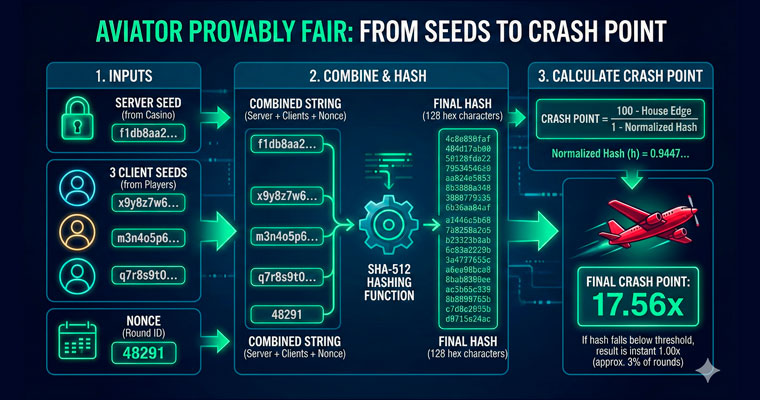
Here is the exact sequence Aviator’s algorithm follows for every round. We’ll use real values to make each step concrete.
Step 1: Concatenate the Inputs
The four seed components and the nonce are joined into a single string with no separators:
ServerSeed = “a1b2c3d4e5f6…”
ClientSeed1 = “x9y8z7w6…”
ClientSeed2 = “m3n4o5p6…”
ClientSeed3 = “q7r8s9t0…”
Nonce = 48291// Concatenation (no spaces, no separators)
CombinedString = ServerSeed + ClientSeed1 + ClientSeed2 + ClientSeed3 + Nonce
The order matters. Changing even a single character in any of these inputs produces a completely different hash in the next step.
Step 2: Hash with SHA-512
The combined string is passed through SHA-512, a cryptographic hash function that produces a fixed-length 128-character hexadecimal output:
Hash = SHA512(CombinedString)
// Example output (128 hex characters):
f1db8aa208e175c3a9b2…e4f7 (truncated for display)
Key properties of SHA-512 that make it suitable for provably fair gaming:
| Property | What It Means | Why It Matters |
|---|---|---|
| Deterministic | Same input always produces same output | Anyone can reproduce the result for verification |
| One-way | Cannot reverse-engineer the input from the output | Seeing the hashed server seed reveals nothing about the crash point |
| Avalanche effect | A tiny input change flips ~50% of output bits | No “close guesses” — you either know the input or you don’t |
| Collision-resistant | Virtually impossible for two different inputs to produce the same hash | Each round is uniquely determined |
Step 3: Extract the Numeric Value
The first 13 hexadecimal characters (52 bits) of the hash are extracted and converted to a decimal number:
hexSlice = “f1db8aa208e17”// Convert to decimal integer
decimalValue = parseInt(“f1db8aa208e17”, 16)
decimalValue = 4,254,803,616,108,055// Normalize to [0, 1) by dividing by 2^52
h = decimalValue / 252
h = 4,254,803,616,108,055 / 4,503,599,627,370,496
h = 0.94475618797
The value h is now a number between 0 and 1. It represents where this particular round falls in the probability distribution. A higher h (closer to 1) typically means a higher multiplier.
Step 4: Apply the Crash Point Formula
This is where the multiplier is actually calculated. The formula translates the normalized hash value into a crash point, accounting for the house edge:
• h = normalized hash value (from Step 3), range [0, 1)
• HouseEdge = 3 for Aviator (97% RTP)
• Result is floored to two decimal places (e.g. 17.549 becomes 17.54x)
Worked Example
Given: h = 0.94475618797, HouseEdge = 3
Step A: (100 – 3) = 97
Step B: (1 – 0.94475618797) = 0.05524381203
Step C: 97 / 0.05524381203 = 1,756.076…
Step D: 1,756.076 / 100 = 17.56x (floored to 17.56x)
This round’s multiplier is 17.56x. Anyone holding a cashout target at or below 17.56x would win; anyone aiming higher would lose.
Step 4b: The Instant Round (1.00x) Check
Before applying the formula above, the algorithm performs one additional check. If the hash value falls below a certain threshold, the round ends at 1.00x — no cashout is possible for anyone.
The rule: The algorithm generates a secondary value from the hash. If this value modulo floor(100 / HouseEdge) equals 0, the round is an instant 1.00x.
For Aviator (3% house edge): floor(100 / 3) = 33. So if the check value modulo 33 equals 0, the multiplier is forced to 1.00x.
Probability: 1/33 ≈ 3.03% of rounds — almost exactly equal to the house edge.
This is not arbitrary. The instant-round mechanism is what creates the house edge. Without it, the expected multiplier distribution would be perfectly fair (100% RTP). The 3% of rounds that end at 1.00x are the casino’s profit margin, baked directly into the cryptographic process.
The Probability Distribution: Why Low Multipliers Are Common

The crash point formula produces a geometric distribution. This means that low multipliers happen frequently and high multipliers are exponentially rare. For Aviator by Spribe and every other provably fair implementation, the probability of the round reaching any multiplier m or higher is:
This formula isn’t an approximation — it follows directly from the hash-to-multiplier conversion. Here’s what it produces in practice:
| Target Multiplier | Probability of Reaching It | In Plain Terms |
|---|---|---|
| 1.00x (instant) | ~3% end here | 1 in 33 rounds |
| 1.50x | 64.67% | ~2 in 3 rounds |
| 2.00x | 48.50% | ~1 in 2 (not exactly half) |
| 5.00x | 19.40% | ~1 in 5 rounds |
| 10.00x | 9.70% | ~1 in 10 rounds |
| 50.00x | 1.94% | ~1 in 50 rounds |
| 100.00x | 0.97% | ~1 in 100 rounds |
| 1,000x | 0.097% | ~1 in 1,000 rounds |
Notice the pattern: at any multiplier m, the probability is roughly 1/m (adjusted for the 3% house edge). This elegant relationship is a direct consequence of the hash-to-multiplier formula.
Use our Crash Game Probability Calculator to compute the exact probability for any multiplier on any platform.
How to Verify a Round Yourself
The entire point of Spribe’s provably fair system is that you don’t have to trust anyone. Here’s how to verify any Aviator round in under two minutes.
Method 1: In-Game Verification
- After a round ends, click the Green Shield icon (sometimes labeled “Fairness” or “Provably Fair”) in the Aviator interface. Alternatively, open the hamburger menu → “My Bet History” → click the green icon next to any round.
- Copy the displayed data: server seed, the three client seeds, the combined hash, and the nonce.
- Open any free SHA-512 tool online (search “SHA-512 hash generator”). Paste the seeds in the exact order displayed — server seed first, then client seeds 1, 2, 3, then the nonce — with no spaces or separators.
- Compare hashes: The hash your tool produces should match the one Aviator displayed. If it matches, the input was not tampered with.
- Apply the crash point formula from the section above to confirm the multiplier. Or use our Provably Fair Verifier to do it automatically.
Method 2: Manual Calculation
If you want to go further and actually compute the crash point from the hash, here’s the process in pseudocode:
hash = SHA512(serverSeed + clientSeed1 + clientSeed2 + clientSeed3 + nonce)// 2. Check for instant 1.00x round
checkValue = parseInt(hash.substring(0, 8), 16) // first 8 hex chars
if (checkValue % 33 === 0) {
return 1.00 // instant round, ~3% chance
}// 3. Extract and normalize hash value
hexSlice = hash.substring(0, 13) // first 13 hex chars = 52 bits
h = parseInt(hexSlice, 16) // convert to decimal
// 4. Calculate crash point
e = Math.pow(2, 52) // 4,503,599,627,370,496
crashPoint = Math.floor((100 * e – h) / (e – h)) / 100
// 5. Return with minimum of 1.00
return Math.max(1.00, crashPoint)
The pseudocode above is a simplified representation of the algorithm. Different implementations may vary slightly in how they handle the instant-round check and edge cases, but the core formula — converting a hash to a multiplier through division by 252 — is universal across all legitimate provably fair multiplier games.
Why Prediction Is Mathematically Impossible
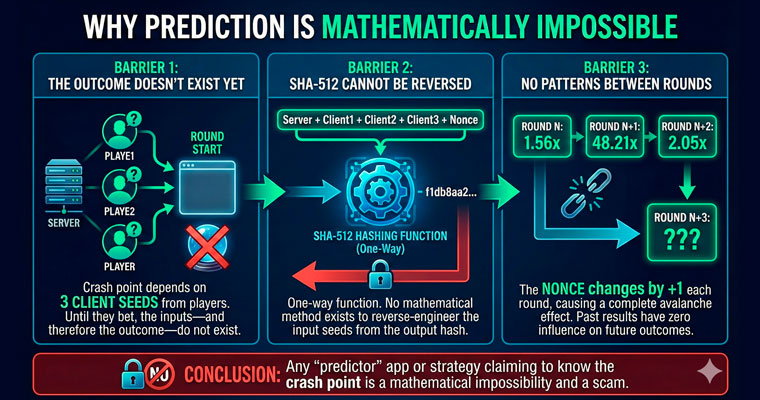
Let’s be precise about this. The claim isn’t just “it’s really hard to predict” — it’s that prediction is logically impossible given Spribe’s provably fair design. There are three independent barriers, each sufficient on its own:
Barrier 1: The Outcome Doesn’t Exist Yet
The crash point depends on three client seeds from three different players. These seeds are generated by each player’s browser at the moment they place a bet. Before that moment, the seeds don’t exist — and neither does the outcome. You cannot predict something that hasn’t been determined.
This is not a minor technicality. It is the fundamental design principle of multi-participant provably fair systems. Even Spribe’s own servers cannot know the result until all three client seeds are received.
Barrier 2: SHA-512 Cannot Be Reversed
Even if you somehow obtained all four seeds before a round started, computing the crash point requires running them through SHA-512. But Aviator shows you the hashed server seed before the round — not the actual seed. Going from the hash back to the original input is computationally infeasible.
How infeasible? SHA-512 has a 512-bit output space. A brute-force search would require checking up to 2512 possibilities — a number larger than the estimated atoms in the observable universe (roughly 2266). No computer, present or foreseeable, can do this.
Barrier 3: No Patterns Exist Between Rounds
Each round uses a different combination of seeds and an incrementing nonce. Because SHA-512 exhibits the avalanche effect (a one-bit change in input flips ~50% of output bits), consecutive rounds bear no mathematical relationship to each other. There are no streaks, no cycles, no patterns — each round is statistically independent.
🚫 The Definitive Test
If any software could reverse SHA-512 or find patterns in its output, the implications would extend far beyond gambling. The same algorithm secures cryptocurrency wallets, banking transactions, government communications, and the entire TLS/HTTPS protocol that protects the internet. The fact that Bitcoin hasn’t been hacked, that online banking still works, and that government secrets remain secret is empirical proof that SHA-512 prediction is not happening.
Aviator vs. Other Provably Fair Systems
Not all multiplier games use the same implementation. Here’s how the major platforms compare technically:
| Feature | Aviator (Spribe) | Bustabit | BC.Game / Stake |
|---|---|---|---|
| Hash function | SHA-512 | HMAC-SHA256 | SHA-256 (varies) |
| Client seeds | 3 players | 1 (hash chain) | 1 |
| RTP | 97% | 99% | 99% |
| House edge | 3% | 1% | 1% |
| Instant 1.00x frequency | ~3% | ~1% | ~1% |
| P(Win) at 2.00x | 48.50% | 49.50% | 49.50% |
| Core formula | CrashPoint = (100 – HouseEdge) / (1 – h) / 100 (identical across all) | ||
| Open source | No (audited) | Yes | Varies |
The core formula is the same across all platforms — what differs is the hash function, the number of client seed contributors, and the house edge. Aviator’s use of three client seeds gives it a stronger fairness guarantee (more independent participants), while Bustabit’s hash chain model allows verification of all past rounds sequentially.
For a detailed probability comparison across platforms, use our Crash Game Probability Calculator — select any platform from the dropdown and enter your target multiplier.
Common Misconceptions
✘ “After 10 rounds below 2x, a high multiplier is due”
This is the Gambler’s Fallacy. Each round is generated from independent inputs — the hash function has no memory. The probability of reaching 2x in round 11 is exactly 48.5%, regardless of what happened in rounds 1-10.
✘ “The casino adjusts results based on player bets”
Impossible. The server seed is hashed and committed before betting opens. If the casino changed the seed after seeing bets, the hash wouldn’t match — and any player could detect the manipulation during verification.
✘ “Predictor apps can crack the algorithm”
Any app claiming to predict outcomes is a scam. To compute the crash point, you’d need the unhashed server seed (hidden until round ends) and three client seeds (generated at bet time by other players). Predictor apps display random numbers — any wins are coincidence.
✔ “The house always has an edge in the long run”
This is correct. The 3% of instant 1.00x rounds ensure that over thousands of rounds, the casino retains 3% of all wagers. No strategy — Martingale, anti-Martingale, fixed multiplier, or anything else — changes this mathematical reality. See our Crash Game Strategy Guide for a full analysis of why, and our Auto-Cashout Optimizer to compare EV across multiplier targets.
Frequently Asked Questions
What is the exact formula Aviator uses to calculate the crash point?
h), normalized by dividing by 252. The crash point is then calculated as: CrashPoint = (100 – HouseEdge) / (1 – h) / 100. Additionally, a separate check determines if the round should be an instant 1.00x (approximately 3% of the time).Can anyone predict the Aviator crash point before a round starts?
How do I verify a round in Aviator is fair?
Why does Aviator use three client seeds instead of one?
What is the probability of the crash point being exactly 1.00x?
Is Aviator’s algorithm the same as Bustabit’s?
Key Takeaways
- The crash point formula is: CrashPoint = (100 – HouseEdge) / (1 – h) / 100, where h is derived from the SHA-512 hash of combined seeds.
- Three independent client seeds ensure no single party controls the outcome.
- ~3% of Aviator rounds end at 1.00x. This is the house edge — mathematically identical to the stated 97% RTP.
- Every round can be verified by anyone with a SHA-512 tool. If the hashes match, the result was not manipulated.
- Prediction is impossible — not “difficult,” but logically impossible — because the outcome depends on inputs that don’t exist until the round starts.
- The probability of reaching multiplier m is always P = RTP / m. Use our probability calculator to check any target.
Understanding the algorithm won’t give you an edge — the math ensures the house always wins over time. But it does give you something equally valuable: the ability to verify fairness rather than taking anyone’s word for it, and the knowledge to avoid predictor scams that exploit players who don’t understand the math.
For strategy analysis based on these probabilities, see Crash Auto-Cashout Optimizer.