
| If you searched for… | Use this answer |
|---|---|
| Aviator SHA-256 formula | SHA-256 is relevant to the server-seed commitment check. It is not the full round-result hash. |
| Aviator SHA-512 verifier | The completed round can be checked by recomputing the SHA-512 hash from the revealed inputs. |
| Hash to multiplier | A 52-bit public reconstruction using a 0.97 constant can reproduce completed-round multipliers when the disclosed hash construction matches the panel. Treat it as a verification model, not published SPRIBE source code. |
| Aviator predictor | Prediction apps cannot know the hidden server seed and full round inputs before the round is resolved. Verification is for completed rounds only. |
Aviator Provably Fair Verifier
Check disclosed commitment/hash values and compare the completed round with the 97%-RTP 52-bit reconstruction matched by all four completed Aviator rounds we tested.
SHA-256 and SHA-512 are the primary verification checks. The displayed multiplier check is a secondary comparison against the 97%-RTP reconstruction.
------What went wrong?
How to Use the Aviator Verifier
- Server seed: paste the revealed server seed from the completed round.
- Client seeds: paste the first three client seeds exactly as shown, one per line and in panel order.
- Round number / nonce: leave this blank for normal Aviator rounds. In the four rounds we tested, the round number was not part of the SHA-512 input. Fill it only if your fairness panel explicitly says it is hashed.
- Structured input separator: keep No separator.
- Structured input order: keep Server + clients (+ nonce if provided).
- Custom combined input: leave blank unless the panel gives you the exact combined string that was hashed. If used, this field overrides the structured inputs for SHA-512.
- Expected server-seed commitment: optional. Paste the pre-round SHA-256 commitment if you captured it before the round.
- Expected round hash: optional. Paste the Combined SHA512 Hash shown by the panel.
- Displayed multiplier: optional. Paste the round result, for example
16.53. - Press Verify Round. A complete check can show Match for the SHA-256 commitment, Match for the SHA-512 hash, and the reconstructed multiplier.
Real Round Example: 4112625
The screenshots below show the same completed round in the Aviator fairness panel and in the GamblingCalc verifier. The panel result is 16.53x, with first-13-hex value f0fbffc79944c; the verifier reconstructs the same 16.53x.
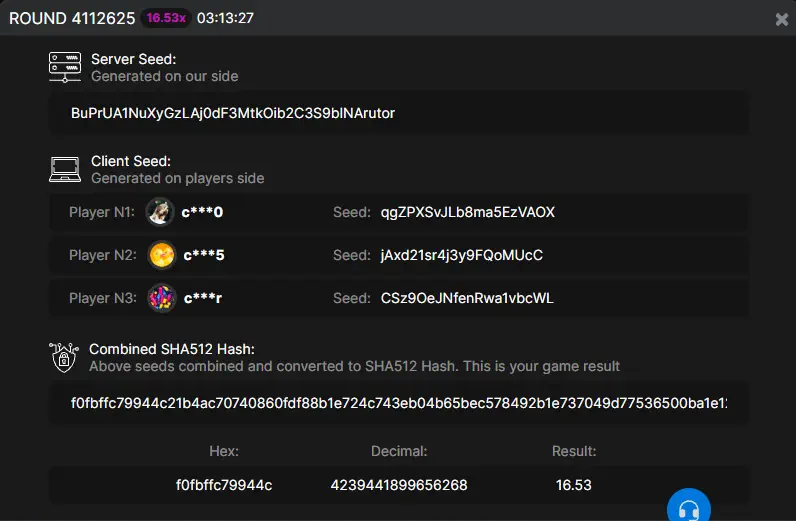
f0fbffc79944c, decimal 4239441899656268, result 16.53x.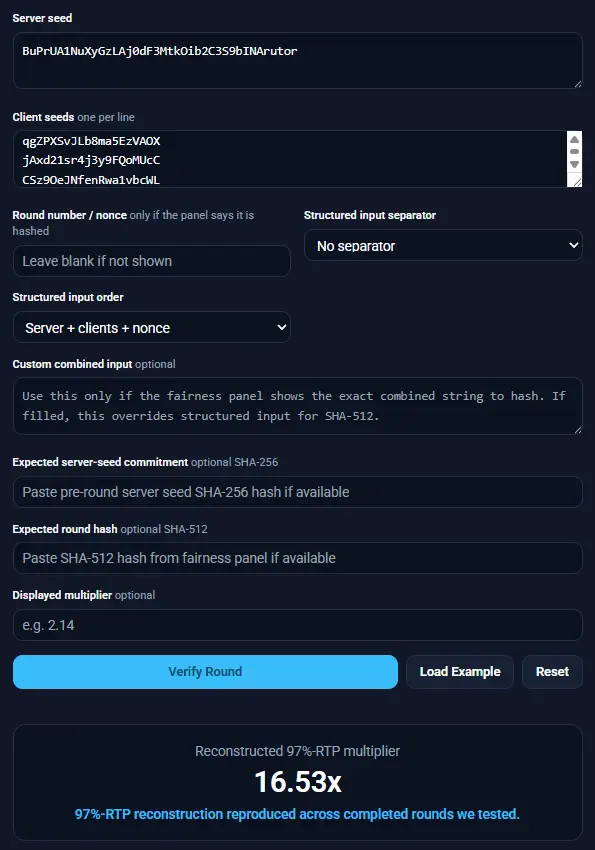
Looking for an Aviator predictor?
A predictor app that claims to forecast the next crash point is not credible. Before the round is resolved, players do not have the revealed server seed and complete input data needed to reproduce the result. The verifier below checks completed rounds; it does not predict future multipliers.
How Aviator Provably Fair Verification Works
Aviator uses a commit-and-reveal style verification flow. Before a round begins, the operator creates a server seed and publishes a hashed version of that seed. After the round, the revealed inputs can be checked against the values shown in the fairness or game-history panel.
The practical idea is simple:
- Before the round: the game shows a server-seed commitment, often labelled as a SHA-256 hash.
- During or after the round: the server seed and client seeds are used to produce a SHA-512 round hash.
- After the round: the player can recompute the hash and compare it with the panel.
If the recomputed hash matches the displayed hash, the revealed inputs are consistent with the fairness panel. That does not make the game profitable; it only checks that the completed round can be reproduced from the disclosed data.
SHA-256 vs SHA-512 in Aviator
The confusion comes from using the word “hash” for two different checks.
| Verification part | Hash function | What it checks |
|---|---|---|
| Server-seed commitment | SHA-256 | Checks whether the later revealed server seed matches the pre-round commitment. |
| Completed round hash | SHA-512 | Checks whether the revealed round inputs reproduce the hash shown by the fairness panel. |
So the accurate answer is not “Aviator uses only SHA-256” or “Aviator uses only SHA-512.” SHA-256 can appear in the server-seed commitment step, while SHA-512 is used for the completed round hash.
Inputs: Server Seed, Client Seeds and Round Number
Server Seed
The server seed is generated before the round. A hashed version is shown before the result so the operator cannot quietly swap the seed later without detection.
Client Seeds
Client seeds are generated on the player side. The fairness panel may show multiple client seeds. Use exactly the seeds shown there, in the same order.
Round Number or Nonce
Some verification panels include a round number, nonce, or similar value. If the panel shows it as part of the hash input, include it. If the panel does not show such a value, leave the field blank.
In all four completed Aviator rounds we checked, including three captured in August 2026, the SHA-512 value was reproduced by concatenating the server seed and the first three client seeds in panel order, with no separator and without the round number. SPRIBE’s public Provably Fair explanation describes the same server/client-seed → SHA-512 pipeline. Keep the nonce field optional: use it only when a specific panel explicitly shows that it is part of the hashed input.
Custom Combined Input
If the fairness panel provides the exact string that was hashed, paste it into Custom Combined Input. The verifier hashes that value exactly and does not trim leading or trailing characters. This is safer than guessing separators or order.
How to Verify a Completed Round
- Open the game history or fairness panel after the round has ended.
- Copy the revealed server seed.
- Copy the client seeds in the same order shown in the panel.
- Copy the round number or nonce if the panel includes one.
- Copy the displayed SHA-512 round hash if available.
- If the panel exposes the exact combined string, use Custom Combined Input instead of guessing its construction.
- Use the verifier to recompute the SHA-256 commitment and SHA-512 round hash.
- Compare the full computed values with the panel.
The hash comparison is the primary fairness check. The multiplier estimate is secondary because the exact interpretation of the SHA-512 hash can depend on game-specific implementation details.
Common Crash-Game Multiplier Model
For the secondary multiplier check, this verifier uses a public 52-bit reconstruction consistent with a 97% RTP model. It takes the first 13 hexadecimal characters of the completed SHA-512 value:
h = parseInt(hash.substring(0, 13), 16)
x = h / e
multiplier =
max(1.00, floor((0.97 / (1 – x)) * 100) / 100)
The equivalent exact-cent form is max(1.00, floor((97 * e) / (e - h)) / 100). The 0.97 constant incorporates the 3% edge implied by a 97% RTP model, so this verifier does not add a separate 1-in-33 instant-crash rule.
The formula is not presented as published SPRIBE source code. It is an independent reconstruction reproduced across all four completed rounds we tested: 5.12x, 1.24x and 16.53x from three August 2026 rounds, plus 20.13x from an earlier FUN MODE round. Several of these cases distinguish floor from normal rounding, and the panel result matched floor each time.
The primary fairness check remains the disclosed hash comparison. If a specific game information panel shows an RTP other than 97%, this 0.97-based reconstruction should not be expected to reproduce that build’s multiplier distribution.
Need the Hash-to-Multiplier Math?
For a deeper explanation of the 52-bit crash-game model, SHA-512 hash slicing and why SHA-256 cannot be converted into a future multiplier, see the
Aviator Hash to Multiplier guide.
Can Aviator Be Predicted?
No credible public method can predict the next round before the necessary inputs are known. The server seed is hidden behind a hash commitment before the round, and the full round data becomes useful only after the fairness panel reveals it.
Hash functions are designed to be one-way. Seeing a hash does not reveal the hidden seed. Verification can check a completed round; it cannot turn future rounds into known outcomes.
What This Verifier Can and Cannot Prove
| Claim | Can this verifier prove it? |
|---|---|
| The revealed server seed matches the pre-round commitment. | Yes, if the expected SHA-256 commitment is provided. |
| The revealed inputs reproduce the displayed SHA-512 round hash. | Yes, if input order and formatting match the fairness panel. |
| The 97%-RTP 52-bit reconstruction produces the displayed multiplier. | It can be compared directly. A mismatch does not by itself prove the round was unfair because the public reconstruction is separate from the cryptographic hash check. |
| The next round can be predicted. | No. |
| Verification removes the house edge. | No. It only checks consistency of a completed round. |
Frequently Asked Questions
Does Aviator use SHA-256 or SHA-512?
Both can appear in the verification flow. SHA-256 may be used for the server-seed commitment, while SHA-512 is used for the completed round hash.
How do I verify an Aviator round?
Copy the revealed server seed and the first three client seeds in panel order. In the completed rounds we tested, they were concatenated with no separator and no round number. Add a nonce only if a specific fairness panel explicitly states that it is part of the hashed input. If available, also paste the pre-round SHA-256 commitment, the displayed SHA-512 hash and the multiplier so the verifier can compare them directly.
Can the verifier predict the next multiplier?
No. The verifier checks completed rounds. It cannot predict future outcomes before the hidden seed and full round inputs are revealed.
Why can the multiplier estimate differ?
The SHA-512 hash check is the primary verification step. The multiplier estimate uses a 97%-RTP public reconstruction and may differ if the supplied combined input is wrong, if the game information shows another RTP, or if the production multiplier mapping includes details not represented by the reconstruction.
Why does SPRIBE’s own Provably Fair illustration show 2.17x for SHA-512 of ABCDEFGH?
The illustration’s SHA-512 is valid: SHA512("ABCDEFGH") begins 8b66b893918da. The 97%-RTP reconstruction that matched all four completed rounds we tested gives 2.12x for that hash, while 2.17x is consistent with a coefficient around 0.99. SPRIBE does not publish the proprietary multiplier mapping or explain the illustration’s coefficient, so the verifier keeps 97% fixed for current tested rounds and treats the illustration as a documented discrepancy rather than evidence of a current 99% mode.
Does provably fair mean profitable?
No. Provably fair means a completed round can be checked for consistency. It does not remove the house edge or guarantee profit.
Source note: SPRIBE’s public Provably Fair explanation describes the server-seed SHA-256 commitment, client seeds from the first three bettors, concatenation and SHA-512 pipeline. Its public Aviator information lists 97% RTP. SPRIBE does not publish the proprietary SHA-512-to-multiplier mapping, so the multiplier step here remains an independent reconstruction. All four completed rounds we tested matched the 0.97 coefficient with floor to cents; three of those rounds were captured in August 2026.
Responsible gambling notice: provably fair verification checks whether a completed round is consistent with the revealed inputs. It does not predict future outcomes and does not make the game profitable. Never wager more than you can afford to lose.
Am a gamble from Africabat so am using aviator to build my future but most of the time this thing is killing me slowly slowly am losing alot of money trying my best but am not getting anything but am still trying so how can I know the rush flying more of plane
Hi, Mthandazo! Thank you for being honest about what is happening.
Unfortunately, there is no way to know in advance which Aviator round will fly higher. Each round is generated from hidden data, and previous low or high multipliers do not reveal what the next round will do. Provably fair verification can check a completed round, but it cannot predict a future one. Any app, signal group or person claiming to know the next multiplier is not reliable.
More importantly, you said that you are losing a lot of money and that the game is “killing you slowly.” Please do not keep trying to recover your losses. Aviator should not be treated as a way to build your future or earn an income. Chasing losses usually leads to larger losses.
The safest step is to stop playing now, withdraw any remaining balance, activate a cooling-off period or self-exclusion, and ask the casino to block further deposits. Tell someone you trust what is happening and consider contacting Gambling Therapy, which provides free and confidential online support worldwide.
If you feel unsafe or think you may hurt yourself, contact your local emergency service or a trusted person immediately. Your safety is more important than any money already lost.
স্যার আমাকে প্রেডিকশন হ্যাক টা প্লিজ দেন আপনাকে পায়ে ধরে অনুরোধ করছি প্লিজ স্যার
আপনার বার্তার জন্য ধন্যবাদ। Aviator-এর পরবর্তী রাউন্ড বা multiplier আগে থেকে জানার কোনো prediction hack নেই। এই সাইটও ভবিষ্যতের ফল বলে না—এখানে শুধু শেষ হয়ে যাওয়া রাউন্ডের fairness যাচাই করার পদ্ধতি ব্যাখ্যা করা হয়েছে।
যে ব্যক্তি, অ্যাপ, Telegram গ্রুপ বা ভিডিও নিশ্চিত prediction বা hack দেওয়ার দাবি করে, সে আপনাকে প্রতারণা করছে। আগের multiplier দেখে পরের multiplier অনুমান করা যায় না। এমন কোনো সফটওয়্যার বা সংকেত নেই যা আগে থেকে সঠিক ফল জানাতে পারে।
অনুগ্রহ করে prediction বা হারানো টাকা ফেরত পাওয়ার আশায় আরও টাকা জমা দেবেন না। যদি খেলা নিয়ন্ত্রণ করা কঠিন হয়ে যায়, এখনই বিরতি নিন, deposit limit বা self-exclusion চালু করুন এবং বিশ্বাসযোগ্য কারও সঙ্গে বিষয়টি নিয়ে কথা বলুন। কোনো hack আপনার টাকা নিরাপদ রাখতে পারবে না—খেলা বন্ধ করাই সবচেয়ে নিরাপদ সিদ্ধান্ত।
Aviator game projector
It sounds like you are looking for an Aviator game predictor. No legitimate predictor can reveal the next multiplier or crash point in advance. Future rounds cannot be calculated from previous results, and apps or groups claiming to provide accurate predictions are scams.
This page explains how completed rounds can be verified as provably fair; it does not predict future rounds.
Plz help me
How can we help you?
Yes help mi my name is Surendra
Hi Surendra. We can help — please tell us what exactly you are having trouble with.
If you want to verify an Aviator round, let us know which part you do not understand and we can explain it step by step. Please do not post any passwords, account details or other private information here.
Just to clarify: the provably fair verifier can be used to check completed rounds, but it cannot predict the multiplier or crash point of a future round.
Plz help I lost to much money
Hi. If you have already lost too much money, please stop playing and do not try to win it back by placing more bets.
There is no Aviator strategy, predictor, hack or provably fair tool that can recover previous losses or tell you the next multiplier. Chasing losses usually makes the situation worse.
If possible, withdraw any remaining balance, set a deposit block or self-exclusion on your gambling account, and speak to someone you trust about what is happening. You can also contact a gambling-support service such as Gambling Therapy for free and confidential help.
If the losses are affecting your ability to pay for food, housing, bills or debts, treat that as a sign to stop gambling completely and seek financial or gambling-support help rather than trying another round.
Sir I need your help I don’t know how to make use of probably fair In this app