
Many players search for an Aviator hash to multiplier formula because they want to understand how a completed round can be checked. The key distinction is simple: a completed-round hash can be tested against a deterministic model, but a pre-round commitment hash does not reveal the next multiplier.
SPRIBE’s public Aviator product page lists 97% RTP. We independently reproduced the same 52-bit, floor-to-cents multiplier model across all four completed rounds we tested, including three current rounds captured in August 2026. SPRIBE does not publish the proprietary hash-to-multiplier mapping, so this remains a reconstruction rather than a source-code claim.
Aviator Hash to Multiplier Demo
Paste a completed-round SHA-512 hash to run a reconstructed 52-bit model calibrated to Aviator's published 97% RTP.
e = 2^52
h = parseInt(hash.substring(0, 13), 16)
x = h / e
multiplier = max(1.00, floor((0.97 / (1 - x)) * 100) / 100)Equivalent exact-cent form:
multiplier = max(1.00, floor((97 * e) / (e - h)) / 100)What went wrong?
How to Use the Hash-to-Multiplier Calculator
- Open a completed Aviator round in the Provably Fair / history panel.
- Copy the full Combined SHA512 Hash. It must contain 128 hexadecimal characters.
- Paste it into Completed-round SHA-512 hash.
- Optionally enter a target cashout such as
2.00. - Press Calculate Model Multiplier. The tool always uses the verified floor-to-two-decimals rule; there is no round selector.
Where to Find a Real Aviator SHA-512 Hash
The calculator needs the full Combined SHA512 Hash from a completed round. Open the completed round in Aviator’s history / Provably Fair panel and copy the complete 128-character SHA-512 value.
- Use: the full Combined SHA512 Hash shown after the round.
- Do not use: a 64-character SHA-256 server-seed commitment.
- Do not use: a 32-character token, truncated value, round ID, server seed, or only the first 13 hex characters.
The field above shows a live character counter. A valid completed-round SHA-512 input must reach 128 / 128 hex characters before the multiplier can be reconstructed.
Click Load Verified Real Round. It loads round 4112625, whose fairness panel displayed 16.53x; the 97%-RTP reconstruction also returns 16.53x.
For the server-seed commitment, combined SHA-512 input and displayed-hash checks, use the
Aviator Provably Fair Verifier.
Quick Answer: Can You Convert an Aviator Hash to a Multiplier?
For a completed round, the reconstruction used here takes the first 52 bits of the SHA-512 hash, converts them into a uniform value between 0 and 1, and applies the 97%-RTP crash distribution. In our checks it reproduced the displayed multiplier in four out of four completed Aviator rounds.
Three cautions matter:
- A commitment hash is not a prediction input. A pre-round commitment is designed to hide the underlying seed while proving later that it was not changed.
- The calculator needs the completed-round SHA-512 value. A SHA-512 hash is 128 hexadecimal characters.
- SPRIBE does not publish the proprietary hash-to-multiplier formula. The 52-bit formula below is an independently reproduced 97%-RTP reconstruction, not a claim about official source code.
The correct framing is therefore: reconstruct a completed round, not predict a future one.
Why SHA-256 to Multiplier Is the Wrong Question
The query “convert SHA-256 to Aviator multiplier” often mixes up a commitment step with a completed-round result.
| Value | Typical verification role | Can it reveal the next multiplier? |
|---|---|---|
| Pre-round commitment hash | Commits to a hidden server value before it is revealed. | No. |
| Completed-round SHA-512 hash | Can be checked after the round and used as input to a public multiplier reconstruction. | No future prediction; completed rounds only. |
A cryptographic commitment is intentionally one-way. Knowing the hash does not give you the hidden seed, so it cannot be reversed into a future crash point.
The 97%-RTP 52-Bit Hash-to-Multiplier Model
SPRIBE lists Aviator at 97% RTP. A common public reconstruction uses the first 13 hexadecimal characters of the completed SHA-512 hash. Thirteen hex characters contain 52 bits.
h = parseInt(hash.substring(0, 13), 16)
x = h / e
multiplier =
max(1.00, floor((0.97 / (1 – x)) * 100) / 100)
The same floor-to-cents calculation can be written as:
max(1.00, floor((97 * e) / (e – h)) / 100)
The max(1.00, ...) floor matters. When the raw 97%-RTP value is below 1.00, the displayed model result is 1.00x. This produces the low-end region associated with the model’s 3% house edge; a separate “1 in 33” rule should not be added on top of this formula because that would apply another edge mechanism.
Why the Model Is Consistent With 97% RTP
Ignoring the two-decimal floor for a moment, the model implies an approximate probability of reaching a target multiplier M of:
At a 2.00x cashout, for example, the model reaches the target about 48.5% of the time. A fixed 2.00x cashout therefore has an expected return of approximately 2.00 × 48.5% = 97% before discrete rounding effects.
Step-by-Step Example
For a completed SHA-512 hash, the calculator follows this process:
- Validate the hash. It must contain exactly 128 hexadecimal characters.
- Read the first 13 hex characters. This is the 52-bit slice used by the reconstruction.
- Convert the slice to an integer.
- Normalize it by 252.
- Apply the 97%-RTP formula.
- Floor to two decimal places.
- Clamp any value below 1.00 to 1.00x.
Worked line from real round 4112625: f0fbffc79944c → h = 4239441899656268 → x = 0.9413452017 → raw model value 16.5374… → floor to two decimals → 16.53x.
Verified Real Aviator Results
We checked the reconstruction against four completed Aviator rounds. Three were captured in August 2026 and one was an earlier FUN MODE example. All four matched 0.97 + floor to two decimals; none matched a 0.99 coefficient or normal rounding, and the tested cases that distinguish floor from normal rounding all confirmed floor.
| Round | First 13 hex | Displayed | 97% floor |
|---|---|---|---|
| 4112623 | cf92858df1877 | 5.12x | 5.12x |
| 4112624 | 38c394b55c500 | 1.24x | 1.24x |
| 4112625 | f0fbffc79944c | 16.53x | 16.53x |
| N1423259 | f3ab4957bc5b0 | 20.13x | 20.13x |
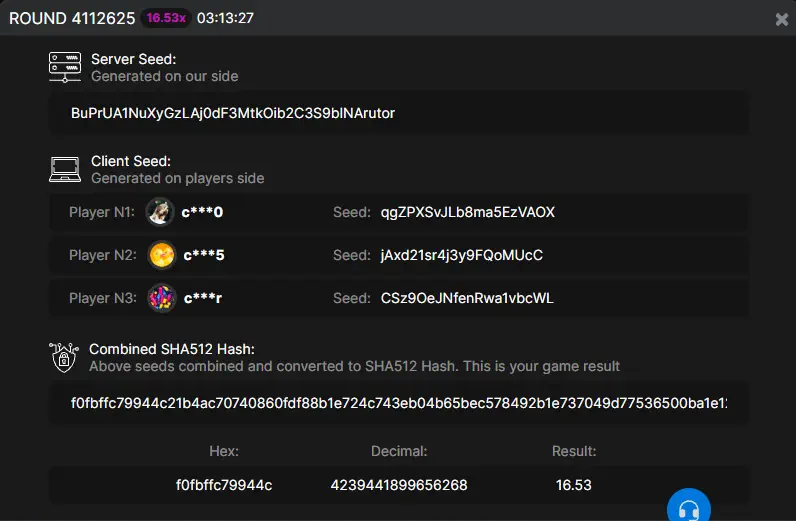
f0fbffc79944c, decimal 4239441899656268, displayed result 16.53x.Round 4112625 is the built-in example. Its completed SHA-512 is f0fbffc79944c21b4ac70740860fdf88b1e724c743eb04b65bec578492b1e737049d77536500ba1e12b7a1e326fafac594fd98e07b835ee863b804c8e86808b3, and the first 13 characters f0fbffc79944c reconstruct to 16.53x. The same round also passed the full commitment chain in the Verifier: the pre-round SHA-256 commitment matched SHA-256 of the later-revealed server seed, and SHA-512 of server seed + three client seeds matched the panel hash.
Across the completed rounds we checked, the combined SHA-512 input was the plain concatenation of the server seed and the first three client seeds in panel order, with no separators and no round number. SPRIBE’s public Provably Fair explanation describes the same server-seed/client-seed → SHA-512 pipeline, but does not publish the multiplier mapping.
The calculator intentionally has only one rounding rule. A verification tool should not let the user switch between “round” and “floor” because the same hash could otherwise produce two different answers.
Why Your Result May Differ from the Fairness Panel
A mismatch does not automatically mean the game is unfair. It means the public reconstruction and the panel are not producing the same multiplier from the value you supplied.
- Wrong value: a commitment hash or copied interface text was pasted instead of the completed-round SHA-512 hash.
- Incomplete round data: the SHA-512 value itself may have been reconstructed from the wrong server/client input combination.
- Input-order or separator mismatch: the exact string hashed by the game may differ from a guessed concatenation.
- Provider-specific mapping: the public 97%-RTP reconstruction may not be identical to the provider’s unpublished production implementation.
- Different RTP shown in the game information: this reconstruction assumes a 0.97 constant. If a specific game build displays another RTP, the same constant should not be expected to reproduce it.
If you have the server seed, client seeds and the hash shown by the fairness panel, use the Aviator Provably Fair Verifier first. A matching disclosed hash is a stronger verification signal than matching a community-reconstructed multiplier formula.
Can This Predict the Next Aviator Round?
No. The formula only maps a value that is already known after the relevant round data is available. It does not reverse a cryptographic commitment and does not reveal hidden inputs before the round.
Any service claiming to forecast the next multiplier from a visible commitment hash should therefore be treated with caution.
What This Page Can and Cannot Do
| Claim | Answer |
|---|---|
| Validate a 128-character completed SHA-512 value | Yes. |
| Apply a 52-bit multiplier reconstruction consistent with 97% RTP | Yes. |
| Guarantee the exact proprietary SPRIBE multiplier implementation | No. |
| Convert a pre-round commitment into the next result | No. |
| Predict future rounds | No. |
Frequently Asked Questions
Can SHA-256 be converted to an Aviator multiplier?
Not as a future prediction. A pre-round commitment hash is designed to hide its underlying seed. The hash-to-multiplier tool on this page expects a completed-round 128-character SHA-512 value.
What hash is used for the completed round?
This tool expects the completed-round SHA-512 value: 128 hexadecimal characters. In all four completed rounds we checked, the SHA-512 was reproduced from the revealed server seed plus the first three client seeds in panel order with no separators and no round number. Use the exact value shown by the fairness panel for the round you are checking.
What formula does this calculator use?
It uses the first 52 bits of the supplied SHA-512 hash and applies a public reconstruction equivalent to 0.97 / (1 − x), floored to two decimals and clamped to a minimum of 1.00x. This is consistent with Aviator’s published 97% RTP but is not claimed to be published SPRIBE source code.
Why does SPRIBE’s own Provably Fair illustration show 2.17x for SHA-512 of ABCDEFGH?
SPRIBE’s public illustration hashes ABCDEFGH to a SHA-512 value beginning 8b66b893918da and labels the result 2.17x. With the 97%-RTP reconstruction that matched all four completed rounds we tested — three of them captured in August 2026 — the same hash gives 2.12x. A 2.17x result is consistent with a coefficient around 0.99. SPRIBE does not publish the proprietary mapping or explain this difference, so we do not treat the illustration as proof that current rounds use 99%.
Why is there no rounding selector?
The model always floors to two decimal places. Allowing a second rounding mode would make one hash produce different answers and would weaken the value of the tool as a verifier.
Why does the calculator require 128 hexadecimal characters?
SHA-512 output is 512 bits, normally represented by 128 hexadecimal characters. A 64-character value is usually a SHA-256 commitment, while a 32-character or otherwise truncated value is also incomplete. This tool requires the full 128-character Combined SHA512 Hash from a completed round.
Can this formula predict the next round?
No. It only maps a completed-round hash to a reconstructed multiplier. It cannot reveal hidden inputs or predict future crash points.
Source note: SPRIBE’s public Provably Fair explanation describes the server-seed commitment, the first three client seeds, concatenation and SHA-512 pipeline; its Aviator product page lists 97% RTP. SPRIBE does not publish the proprietary SHA-512-to-multiplier mapping. The formula on this page is therefore described as an independent reconstruction reproduced across four completed rounds we tested.
Responsible gambling notice: verification explains completed rounds. It does not predict future multipliers and does not remove the house edge. Never wager more than you can afford to lose.