

Search for “crash game strategy” and you’ll find dozens of guides recommending the Martingale system, “low multiplier safe bets,” or “pattern tracking.” Almost none of them show actual calculations.
This article is different. We’ll compute the expected value (EV) for every major crash game cashout multiplier, simulate 1,000 rounds to see what actually happens to your bankroll, and mathematically prove why certain popular strategies fail. The conclusion won’t surprise experienced players: no strategy beats the house edge. But the specific numbers might change how you think about which multiplier to target and how much to bet per round.
The Expected Value Formula: Why Every Multiplier Has the Same EV

Before analyzing any strategy, you need to understand one formula. The expected value of a single round tells you how much you’ll win or lose on average:
Let’s compute this for a $1 bet on Aviator (97% RTP) at different cashout targets:
| Cashout Target | P(Win) | Profit if Win | Loss if Lose | EV per Round |
|---|---|---|---|---|
| 1.50x | 64.67% | +$0.50 | -$1.00 | -$0.030 |
| 2.00x | 48.50% | +$1.00 | -$1.00 | -$0.030 |
| 3.00x | 32.33% | +$2.00 | -$1.00 | -$0.030 |
| 5.00x | 19.40% | +$4.00 | -$1.00 | -$0.030 |
| 10.00x | 9.70% | +$9.00 | -$1.00 | -$0.030 |
| 100.00x | 0.97% | +$99.00 | -$1.00 | -$0.030 |
So if the EV is identical, why does the multiplier choice matter? Because of variance — how wild the swings are around that average.
Variance: What Actually Differs Between Strategies
While EV is the same, the experience of playing at different multipliers is radically different. Variance measures how far individual results deviate from the expected value.
| Cashout | Win Rate | Avg Losing Streak | Max Losing Streak (1K rounds) | Variance Profile |
|---|---|---|---|---|
| 1.50x | 64.67% | ~3 | ~8-10 | Low — steady grind |
| 2.00x | 48.50% | ~4 | ~12-15 | Medium — coin-flip feel |
| 5.00x | 19.40% | ~10 | ~25-35 | High — feast or famine |
| 10.00x | 9.70% | ~20 | ~50-70 | Very high — mostly losing |
At 1.50x, you win about 2 out of every 3 rounds. Your bankroll stays relatively stable, drifting slowly downward at 3% of total wagers. At 10x, you lose 9 out of 10 rounds — punctuated by occasional large wins. The average loss rate is the same, but your bankroll will look like a roller coaster.
Use our Crash Game Probability Calculator to see the exact probability and streak odds for any multiplier.
1,000-Round Simulation: What Actually Happens to Your Bankroll
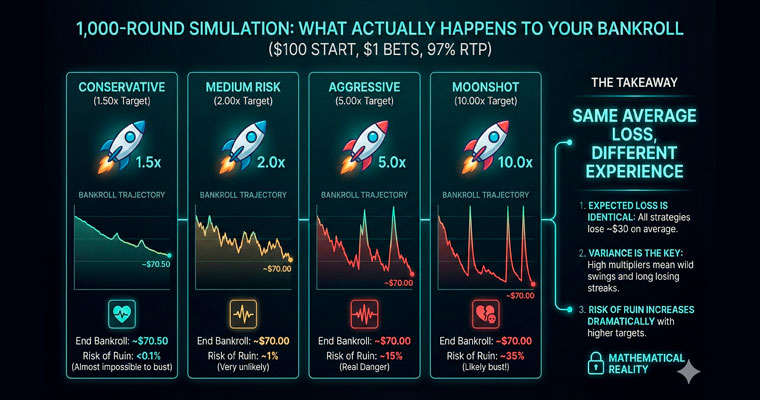
Theory is one thing. Let’s run the numbers on a 1,000-round session with a $100 starting bankroll and $1 flat bets on Aviator (97% RTP / 3% house edge).
Strategy A: Conservative (1.50x Auto-Cashout)
Win rate: 64.67% → ~647 wins, ~353 losses
Total won: 647 × $0.50 = +$323.50
Total lost: 353 × $1.00 = -$353.00
Net result: -$29.50 (expected: -$30.00)
Ending bankroll: ~$70.50
Strategy B: Medium Risk (2.00x Auto-Cashout)
Win rate: 48.50% → ~485 wins, ~515 losses
Total won: 485 × $1.00 = +$485.00
Total lost: 515 × $1.00 = -$515.00
Net result: -$30.00
Ending bankroll: ~$70.00
Strategy C: Aggressive (5.00x Auto-Cashout)
Win rate: 19.40% → ~194 wins, ~806 losses
Total won: 194 × $4.00 = +$776.00
Total lost: 806 × $1.00 = -$806.00
Net result: -$30.00
Ending bankroll: ~$70.00
Strategy D: Moonshot (10.00x Auto-Cashout)
Win rate: 9.70% → ~97 wins, ~903 losses
Total won: 97 × $9.00 = +$873.00
Total lost: 903 × $1.00 = -$903.00
Net result: -$30.00
Ending bankroll: ~$70.00
The critical difference is risk of ruin — the probability of going broke during the session before reaching 1,000 rounds:
| Strategy | Risk of Ruin ($100 bankroll, $1 bets) |
|---|---|
| 1.50x conservative | <0.1% — almost impossible |
| 2.00x medium | ~1% — very unlikely |
| 5.00x aggressive | ~15% — real danger |
| 10.00x moonshot | ~35% — likely bust |
With a 10x target, you can hit a losing streak of 50+ rounds. That’s $50 gone from your $100 bankroll before you see a single win. Many players bust out entirely. At 1.50x, the worst expected streak is about 10 rounds — easily survivable.
Compute your personal risk of ruin with our Risk of Ruin Calculator.
Why the Martingale System Fails: The Math
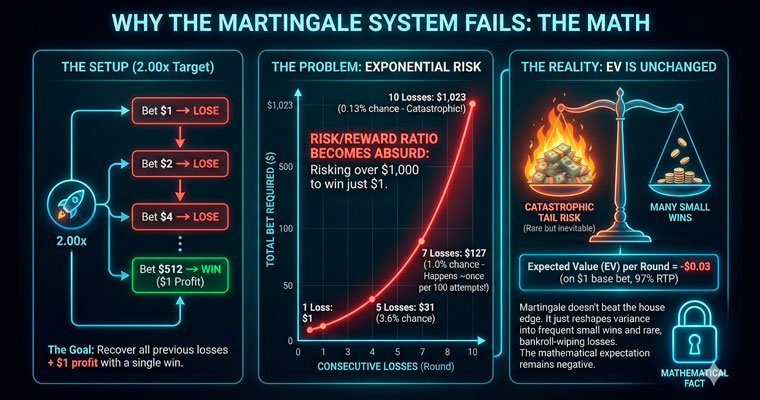
The Martingale strategy — doubling your bet after each loss — is the most popular “system” in crash game circles. Here’s why it mathematically cannot work.
The Setup
Target: 2.00x cashout. Starting bet: $1. Double after each loss. Reset after a win.
| Round | Bet | Total Invested | If Win: Profit | P(Losing This Many in a Row) |
|---|---|---|---|---|
| 1 | $1 | $1 | +$1 | 51.5% |
| 2 | $2 | $3 | +$1 | 26.5% |
| 3 | $4 | $7 | +$1 | 13.7% |
| 4 | $8 | $15 | +$1 | 7.0% |
| 5 | $16 | $31 | +$1 | 3.6% |
| 7 | $64 | $127 | +$1 | 1.0% |
| 10 | $512 | $1,023 | +$1 | 0.13% |
The Problem
After 7 consecutive losses (which has a 1% chance in any given sequence — meaning it will happen roughly once every 100 attempts), you need $127 invested to win $1 profit. After 10 losses, you’ve invested $1,023 for a potential $1 return. The risk/reward ratio is absurd.
In a 1,000-round session with Martingale at 2x, you’ll experience approximately:
• ~10 streaks of 5+ losses (each requiring a $31+ bet to continue)
• ~2-3 streaks of 7+ losses (each requiring $127+ to continue)
• ~1 streak of 10+ losses (requiring $1,023+ to continue)
Expected result: The same -3% loss rate as flat betting, but with the added risk of catastrophic bankroll wipeout during long losing streaks.
The EV of the Martingale is identical to flat betting: -$0.03 per $1 base bet per round. The strategy doesn’t change the math — it simply reshapes the variance into many small wins and rare catastrophic losses.
The Dual-Bet Approach: Does Splitting Help?
Many games (including Aviator) allow placing two simultaneous bets. A popular approach is to split your wager:
Bet 1: $0.70 at 1.50x
The “safety net” — cashes out early to recover part of the total wager. Win rate: 64.67%.
Bet 2: $0.30 at 5.00x
The “upside play” — chases a larger multiplier. Win rate: 19.40%.
Let’s compute the outcomes:
| Scenario | Probability | Bet 1 Result | Bet 2 Result | Net per Round |
|---|---|---|---|---|
| Both win | 19.40% | +$0.35 | +$1.20 | +$1.55 |
| Only Bet 1 wins | 45.27% | +$0.35 | -$0.30 | +$0.05 |
| Both lose | 35.33% | -$0.70 | -$0.30 | -$1.00 |
EV: (0.194 × $1.55) + (0.4527 × $0.05) + (0.3533 × -$1.00) = $0.3007 + $0.0226 – $0.3533 = -$0.030
The dual-bet EV is, once again, exactly -$0.03 per $1 total wagered. The approach doesn’t improve your odds — but it does create an interesting variance profile: you win something in 64.67% of rounds (either +$1.55 or +$0.05) and lose the full amount in 35.33% of rounds. Psychologically, it feels better. Mathematically, it’s identical.
The Only Variable That Changes Your EV: Platform Choice
If no cashout target or betting system changes the EV, what does? The crash game platform’s house edge. This is the single decision under your control that actually affects your expected loss.
| Platform | RTP | House Edge | Loss per 1,000 × $1 Rounds | P(Win) at 2x |
|---|---|---|---|---|
| BC.Game / Stake | 99% | 1% | -$10 | 49.50% |
| Bustabit | 99% | 1% | -$10 | 49.50% |
| Aviator (Spribe) | 97% | 3% | -$30 | 48.50% |
| Unknown scripts | 96% | 4% | -$40 | 48.00% |
The difference is substantial: playing 1,000 rounds on BC.Game (-$10) vs Aviator (-$30) means losing 3x less money. Over longer sessions, this compounds. If you plan to play 10,000 rounds in your lifetime, that’s $100 vs $300 in expected losses — purely from platform choice.
Compare all platforms in detail with our Crash Game RTP Comparison Table.
Bankroll Management: The Only “Strategy” That Matters
Since no crash game betting system changes your EV, the only real strategy is managing how long your bankroll survives. This determines how much entertainment value you extract from a mathematically losing proposition.
The Bet-Sizing Rule
This rule ensures you can survive the worst expected losing streaks at your chosen multiplier:
| Multiplier | Worst Streak (1K rounds) | Min Bankroll at $1/bet | % Rule |
|---|---|---|---|
| 1.50x | ~10 | $50+ | 2% per bet |
| 2.00x | ~15 | $75+ | 1.3% per bet |
| 5.00x | ~35 | $175+ | 0.6% per bet |
| 10.00x | ~70 | $350+ | 0.3% per bet |
Higher multiplier targets require proportionally larger bankrolls to avoid bust. This is the fundamental tradeoff: if you want the excitement of chasing 10x payouts, you need 7x the bankroll of someone targeting 1.5x.
Use our Risk of Ruin Calculator to model your exact bankroll requirements.
Frequently Asked Questions
What is the best cashout multiplier for crash games?
Does the Martingale strategy work in crash games?
Is cashing out at 1.01x a safe strategy?
How many rounds can my bankroll survive?
Does it matter which crash game platform I choose?
What is the 1xBet crash game algorithm and can it be beaten?
Summary: What the Math Actually Tells You
- EV is the same at every multiplier. Cashing out at 1.5x, 2x, 5x, or 100x all produce the same expected loss: (House Edge) × (Total Wagered). On Aviator, that’s 3% of every dollar bet.
- Variance is the real differentiator. Low multipliers (1.5x) give steady, small wins with low risk of ruin. High multipliers (10x+) create a volatile roller coaster with frequent losses and occasional big payouts.
- The Martingale doesn’t work. Nor does any other progressive betting system. They all reshape the variance without changing the EV. Martingale specifically creates catastrophic tail risk.
- Platform choice is the only lever. Playing on 99% RTP (BC.Game, Stake, Bustabit) vs 97% (Aviator) reduces your expected loss by 3x. This is the only decision that actually changes the math.
- Bet sizing determines survival. Bet 1-2% of bankroll per round maximum. Higher multiplier targets require lower bet percentages.
- The house always wins in the long run. These games are entertainment — budget accordingly.
For exact probability calculations at any multiplier, use our Crash Game Probability Calculator. To compare expected outcomes at specific cashout points, try the Auto-Cashout Optimizer.